

I fear we're living in a kind of hell. This is a hell that we're thrown into through no real fault of our own. A hell where we first become victims and then we're made to victimize others who, in turn, become victimizers as well. This vicious cycle continues and rarely is it slowed down or even questioned. We live each day bearing the heavy burden of pain. I do not know what to make of this pain but to declare that I suffer intensely when I allow myself to be connected with my emotions. I work in an environment where to be emotional is to be a liability and where a robotic work attitude is prized above all.
Much of this cruelty is pointless. They are not pieces of a puzzle that God will put together to show us some final meaning. Saul Bellow wrote in Herzog: "You think history is the history of loving hearts? You fool! Look at these millions of dead. Can you pity them, feel for them? You can nothing! There were too many. We burned them to ashes, we buried them with bulldozers. History is the history of cruelty, not love as soft men think."
I saw too many lives cruelly reduced to nothingness in my brief four-day travel with Linh. I sensed a disproportionate amount of hopelessness. Consider the first person Linh pointed out to me as we got off the train station in Kensington. This man, perhaps in his 50s, was standing up just after taking a shit on the sidewalk. I saw him as he was pulling his pants up over his white briefs. Why is he reduced to shitting on the sidewalk, in the cold, without any dignity and privacy? Why was I able to see his white briefs? Think about the last time a stranger saw you pulling up your underwear after you took a shit. Consider Angel and Stephanie. Aged 21 and 30 respectively, without jobs or careers, they are reduced to being on the streets. Constantly exposed to the elements, they must somehow survive with what little they have and hope that they get something to eat, a place to sleep, that no one will rape or rob them, and that they'll keep their sanity despite constantly being in a hostile environment. Consider all the homeless and marginalized people that Linh has photographed and put on his blog. Has America not ended for them all already?
We explored Camden, New Jersey. With streets dead of most lively, regular activity and boarded-up houses, Camden is quiet, desolate. Probably feeling responsible for my life, Linh chose not to explore the depths of the city too much. It is repeatedly ranked as one of the most violent and poorest cities in the nation. It is tempting to blame the violence and crime on black people. In fact, a quick google search for "Camden black population" brings up the website "stuffblackpeopledontlike.blogspot.com". But as Tio Hardiman, creator and director of Violence Interrupters says in The Interrupters, a documentary on his organization, "the African-American community and the Latino community have been beaten down so long with poor schools, lack of jobs, hopelessness, despair. A lot of people can't stick with peace if they don't have a stick that they can hold on to."
Where is the outrage over these atrocities? Where are the marches? We have become tired and apathetic and what little energy we have is directed into manufactured dissent and protests that are risk-free and chic. Making a social statement is as easy as buying a "Je suis Charlie" sticker for your laptop, made in China under practically slave-labor conditions. Buy it now and get free shipping and handling!
This capitalist-consumerist system will know no bounds. It will expand itself into all areas of our lives and it will never be satisfied. It's taking over schools and training young children to be future mindless consumers. It is treating the incarcerated as profit resources. It's influencing the way we think and the way we work in our relationships with our friends, spouses, and even children. In Unconditional Parenting, Alfie Kohn writes:
"In our society, we are taught that good things must always be earned, never given away. Indeed, many people become infuriated at the possibility that this precept has been violated. Notice, for example, the hostility many people feel toward welfare and those who rely on it. ... Ultimately, conditional parenting reflects a tendency to see almost every human interaction, even among family members, as a kind of economic transaction. The laws of the marketplace --- supply and demand, tit for tat --- have assumed the status of universal and absolute principles, as though everything in our lives, including what we do with our children, is analogous to buying a car or renting an apartment. One parenting author --- a behaviorist, not coincidentally --- put it this way: 'If I wish to take my child for a ride or even if I wish to hug and kiss her, I must first be certain that she earned it.'"
This is the same view that enables us to dismiss the homeless as lazy freeloaders. As the system collapses, will we change how we interact with each other? This is not a frivolous question! Any system consists of people and the way we treat each other will go on to reflect how the system as a whole treats us, our environment, and the other beings we share this earth with. These injustices are connected.
Speaking of parenting, let’s look some of the people Linh and I met. When we went into Melissa's bar, we met Ryan. In his 40s, wearing a red CCCP t-shirt and an ushanka, he spoke about the political relations between US and Russia. Ryan knew his history and he was extremely furious at the US. With a blood flushed face and passionate fury, he angrily pointed out how the eastward expansion of NATO was a betrayal to Russia. When pointing out other instances like these, he shared with us his plans:
"I am going to go to Russia next year. I'm going to take my father's US Navy uniform, pour Russian vodka over it and burn it!"
"That's disrespectful. Why do you want to do that?" asked Melissa.
"Why?! Because my father fucked me with the inheritance!"
Linh interjected, "Maybe you should burn your father then."
Ryan suddenly paused. He was taken aback and didn't know how to respond. Was he angry at Linh for having the temerity to make such a suggestion? Or did it sound like a good idea to him? Alice Miller wrote in Thou Shalt Not Be Aware about her patient, Inge. Inge had a lot of anger formed as a reaction against the abuse her parents put her through but she could not express this anger towards them. Miller writes:
"Various defense mechanisms can be used to reach a compromise between the necessity of sparing the feelings of one's parents and the need to express one's own feelings. A patient of mine with a strict religious upbringing, for example, was able to spare her parents by directing her newly awakened rage against God. ... After we gradually gained access to the whole spectrum of her parents' child-rearing principles, her strong animosity toward God paled, and her parents, previously lumped together in her mind with God, came to life. Her first reaction toward them was one of anger, followed by grief. Yet the patient still retained her critical ability, even in theological matters."
Maybe Ryan's anger at the US and his anger at the US for betraying Russia is his anger towards his dad and being betrayed by his dad. I observed a second father-son situation when Linh and I went into another bar. Linh and I were silently listening to the jukebox playing old songs about loss and hurt when Johnny, who was just seated nearby, started chatting with us. He told us about how he made seventeen million dollars and lost them all. "I don't believe you man!" exclaimed Linh. Expecting the skepticism, Johnny showed us his old tax return forms which showed he made a three hundred thousand dollar salary some time ago. Linh and I began bombarding him with questions: "How did you make so much? How did you lose it all? Why are you in this bar now? Why are you carrying these old tax forms?"
Johnny used to have a few different companies, including one in construction. He even made money cooking meth for a while before he went to jail for twenty-nine years. He had some legit businesses after coming back out but he still lost all the money. He told us he lost them because of hookers and because of his dad. Once, he gave his dad a hundred thousand dollars a day for nine days because his dad asked for it. "Money is not my problem. My problem is my dad. I need to see a therapist about it but I already have nine doctors." he told us. From his eyes to his testicles, Johnny suffers from a lot of medical issues. His biggest issue, though, might be the lack of love. He was convinced that love "fucks up everything" and told us about his wife and son. His wife divorced him and his son apparently does not want anything to do with him anymore.
"Maybe your son really wanted a father growing up." I pointed out.
"Well, a father didn't have him; a gangster did." replied Johnny, in a matter-of-fact tone.
The vicious cycle shows up again, from Johnny's dad to Johnny to his son. I do not know how to continue this postcard anymore. The more I reflect on this trip and what I saw, the greater my desperation. The multiplicity of meaning behind my observations resist being arranged neatly in a single narrative strand. The problems and the evil appear intractable. Evil upon evil, suffering upon suffering, all ultimately banal and pointless. In the ending of Akira Kurosawa's Ran, Kyoami cries: "Are there no gods ... no Buddha? If you exist, hear me. You're all cruel and fickle pranksters! You ease your boredom in the heavens by crushing us like worms! Damn you! Is it such sport to see us weep and howl?" Tango hears this and yells in return: "Stop it! Do not curse the gods! It is they who weep. In every age they've watched us tread the path of evil, unable to live without killing each other. They can't save us from ourselves. Stop your crying! Such is the way of the world. Men live not for joy but for sorrow, not for peace but for suffering."
In the canvas of my desperation, there are a few blots of hope. One of them is Concepcion Picciotto, the lone protestor in front of the White House who refuses to be silenced about nuclear weapons. Will we just ignore her, though? When Linh and I spoke to her, I noticed some awfully calm and curious squirrels around her tent. I saw a person trying to take pictures of the squirrels and Ms. Picciotto noticed that as well. Angrily, she commented on how people are stupid and how they would ignore her signs and instead, take pictures of squirrels. Is this not a indictment of society, in general? Are we not ignoring what’s right in front of us? Don't we, in a misguided attempt to ignore evil, focus a lot of time on distractions?
I see too much suffering and sadness and lust for the power to inflict a great amount of damage. I am convinced that a far greater emphasis on compassion and empathy will save us. People's emotions need to be woken up. Once we realize how all these injustices are connected, maybe we will stop. It is why I am vegan and it is why I think everyone should be a vegan too, including Linh. But perhaps, I am mistaken. Perhaps all our proclaimed desires for peace and for happiness is something that we say to convince ourselves we are good and to sleep without our conscience nagging at us. In the present system, we're already turning on each other, albeit indirectly. Perhaps when it collapses, we will forego the facade and just turn on the people around us. Perhaps we will never know joy and are doomed to continue poisoning each other. If the latter ends up being true, then my life is meaningless and I am as good as dead.
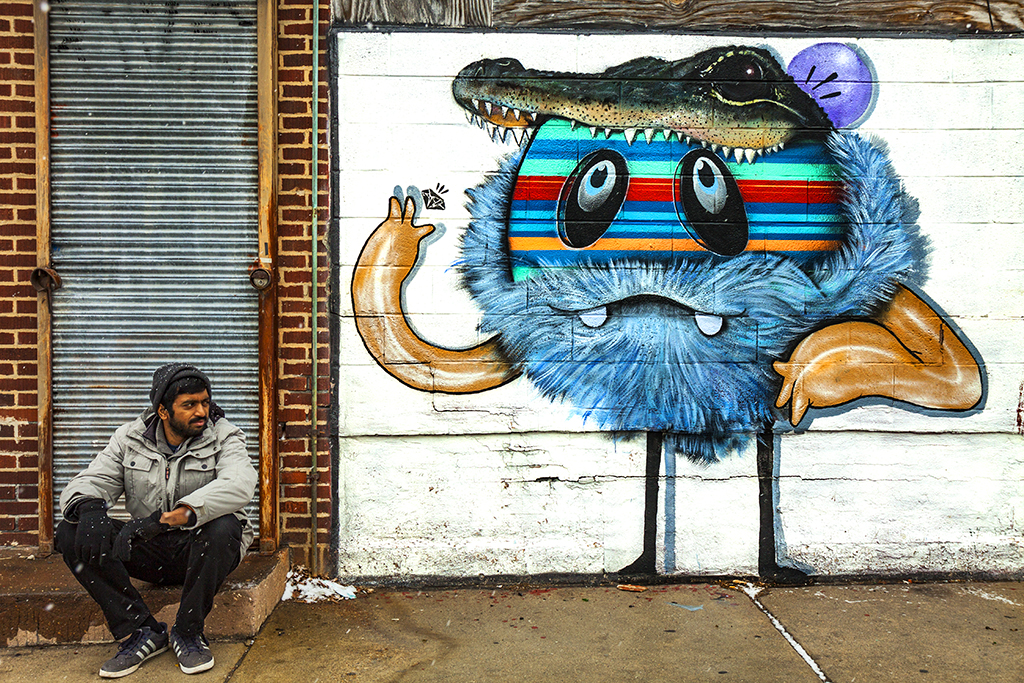
[Ali Razeen in Point Breeze, about a 12-minute walk from my front door.]
.


![[New post] Ontario police catch 18-year-old walking down a street, barefoot and laden with stolen marijuana plants](https://lh3.googleusercontent.com/blogger_img_proxy/AEn0k_sFDVR_YNZ6ugIYpxcziU-Glvm5dn6HWByczCM7l6j4kLTE_IxyLJGmP7SV6QHIYIZoDnrjUQBMTu7_cwdh18OVYGyio0C_Fly6S7STwYou0e_8w8pvGHSAmRDdcHegr1V_z3scIWLvxdpZvZmGu1sGVbm6EGk14wratI2QNhjWXdpndXU4MQ=w100)





0 Yorumlar